A CRM becomes useless when it asks a busy owner to maintain dozens of stages and fields. For many tradies, a small pipeline used consistently is better than an elaborate system nobody trusts.
The recommended seven stages
1. New Enquiry
A new call, form or approved lead enters the system. The next action is to confirm what the customer needs and whether the job fits the service area and business.
2. Attempted Contact
The business has tried to respond but has not yet spoken with the customer. This prevents unanswered return calls from disappearing into a personal call log.
3. Appointment Booked
A consultation, quote visit or suitable appointment has been agreed. Online scheduling is optional; it may suit predictable visits but is not right for every trade or emergency job.
4. Quote Sent
The quote has been delivered and the date is recorded. The system can schedule an appropriate reminder rather than relying on memory.
5. Follow-Up Required
The lead needs a call, email or SMS based on the agreed sales process. Avoid sending repetitive automated messages after the customer has declined or opted out.
6. Won
The customer has accepted and the job can move into the business’s normal delivery system. Recording the source helps compare marketing activity with known commercial outcomes.
7. Lost
The opportunity will not proceed. Where practical, record a simple reason such as price, timing, outside service area, unable to contact or chose another provider.
Keep required fields limited
A useful lead record may need only:
- Name and contact details
- Service required
- Service location
- Enquiry source
- Current stage
- Next action and date
- Known outcome
Decide who owns each new enquiry
Automation can create the record and send an acknowledgement. A person still needs responsibility for qualification, quoting and the next action.
Use automation selectively
Useful examples include:
- Immediate acknowledgement of a website form
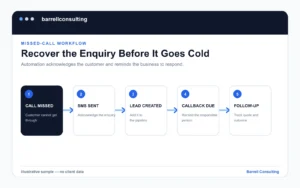
- Missed-call text-back
- A task after an unsuccessful contact attempt
- A quote follow-up reminder
- An appointment reminder for suitable bookings
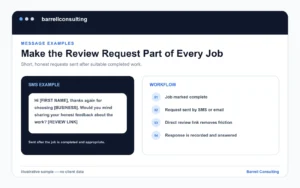
- A genuine review request after completed work
Every workflow should be tested, monitored and stopped when the customer opts out or the stage changes.
Review the pipeline weekly
A short weekly check can reveal new enquiries with no response, quotes with no next action and leads stuck in the wrong stage. The review is often more valuable than adding another automation.
Measure what the system can honestly show
Track enquiries, contact attempts, appointments, quotes and known outcomes. Do not treat missing data as proof of success or failure. Reporting quality depends on the business using the pipeline consistently.
Barrell Consulting can configure this structure, tracking and practical workflows as part of the Complete Local Lead System.